The Osprey Native bridge: one frame in shared memory
Safe, elegant, fast: every Osprey Native app reaches its host the same way. Each call writes one whole frame of fixed-width rows into memory. The host leases that memory, checks every row and draws it where it lies. The app never formats text for the host, and the host never parses any.
New here? Start with Build a counter. This page explains how the bridge works, from the Osprey code that writes a control to the Swift, Rust, C#, Kotlin and TypeScript code that draws it. It also explains why shared rows beat a serialized format such as JSON. The normative contract is spec 0047. The end-to-end explanation is spec 0053.
The app is a library and the host calls it
An Osprey Native app compiles ahead of time to a library:
- a C ABI static archive on macOS, iOS, Android and the desktop targets;
- a DLL on Windows (
--target=windows-x64); - a live WebAssembly module for the web (
--target=wasm32).
The compiler writes a C header beside the library. Every app exports the same three calls, plus its entry:
int32_t osprey_main(void);
int64_t osprey_app_argument(const char *text);
int64_t osprey_app_open(int64_t now, int64_t offset, const char *platform, const char *home, bool dark);
int64_t osprey_app_event(int64_t now, int64_t kind, int64_t ordinal, const char *words, const char *detail,
                         double x, double y, bool down, bool shift);
The host calls osprey_main once. It then calls osprey_app_argument once for each launch argument, then osprey_app_open, then osprey_app_event for everything that follows. All calls come from one thread. Strings are borrowed for the length of the call.
Every call writes one whole frame, including an event the app refused. The app's state stays inside the library between calls. Nothing is saved, sent or restored.
sequenceDiagram
    participant P as Person
    participant H as Host (SwiftUI, WinUI, GPUI, Android, webview)
    participant A as Osprey app (one library)
    participant B as Bridge storage
    H->>A: osprey_app_open(now, offset, platform, home, dark)
    A->>B: append scene rows, view rows, text, ask rows
    A-->>H: 0
    H->>B: osp_native_frame_commit, then acquire, child, length, view
    H->>H: check every row, draw it, release the previous frame
    P->>H: tap, type, drag
    H->>A: osprey_app_event(now, kind, ordinal, words, …)
    A->>B: the next frame
    A-->>H: 0 delivered, 1 refused
One frame, four runs
A published frame is one branch chunk that owns four sealed runs, always in this order:
| Run | Row | Bytes per row | Holds |
|---|---|---|---|
| Scene rows | SceneShape |
88 | a canvas's shapes, sprites, lettering and accessible elements |
| View rows | ViewRow |
152 | the controls and component rows of the screen |
| Text | — | — | the UTF-8 bytes that every row names by offset and length |
| Ask rows | AskRow |
32 | capability requests, slice writes and diagnostics |
Rows are fixed-width, little-endian and 8-byte aligned. A row never holds a pointer: its text is an offset and a length into the frame's one text run. A frame holds at most 220 scene rows, 216 view rows, 224 text bytes and 216 ask fields. An app that goes past a limit has its frame refused; the bridge does not grow without bound.
The model
The bridge has one definition, native.td, written in typeDiagram. typeDiagram generates native_abi.h, the header every host builds against. The header gives each field's offset and a fingerprint of the whole layout, for 64-bit hosts and for wasm32.
These diagrams show the frame's rows, the host event and the ownership types, taken from native.td. Frame and HostEvent name the four runs and the nine event arguments so you can see them as types. On the bridge they are a branch chunk and the arguments of a call.
Every byte the host reads is reached through a lease. These are the ownership types: who may read which allocation, at which generation, and what a refusal says.
BridgeError has more cases than the diagram shows; native.td lists all thirteen. Every bridge entry returns 0 or one plus a BridgeError tag, so each host turns the status into a typed refusal that names the case.
Osprey writes the rows
An app describes its screen as a View, or as components such as Button, Field and Tabs, and decides every colour, size and space in Osprey. Rendering performs a ViewStream effect for each control. The boundary handles that effect with Views::shared, which hands each row to the runtime (view.ospml):
export shared work =
    handle ViewStream
        place drawn => nativeViewRow (drawn.placedKind, drawn.placedParent, drawn.placedAction, drawn.placedWords, drawn.placedLook.ink, drawn.placedLook.fill, drawn.placedLook.points, drawn.placedLook.inset, drawn.placedLook.gap, drawn.placedLook.corner, drawn.placedLook.heft)
        size fitting => nativeViewExtend (fitting.fittedRow, fitting.fittedAs.wide, fitting.fittedAs.tall, fitting.fittedAs.share, fitting.fittedAs.traits, fitting.fittedAs.edge, fitting.fittedAs.hint)
        sketch drawn => Streams::write (drawn.sketchedRow, drawn.sketchedAs)
        ask row => nativeAsk (row.askedField, row.askedNumber, row.askedText)
    work ()
Because the bridge is reached through an effect, a test can swap the handler. Views::quiet handles the same effect by dropping every row, and @osprey/uitest reads the rows a host would get with no host running. The rendering code never changes.
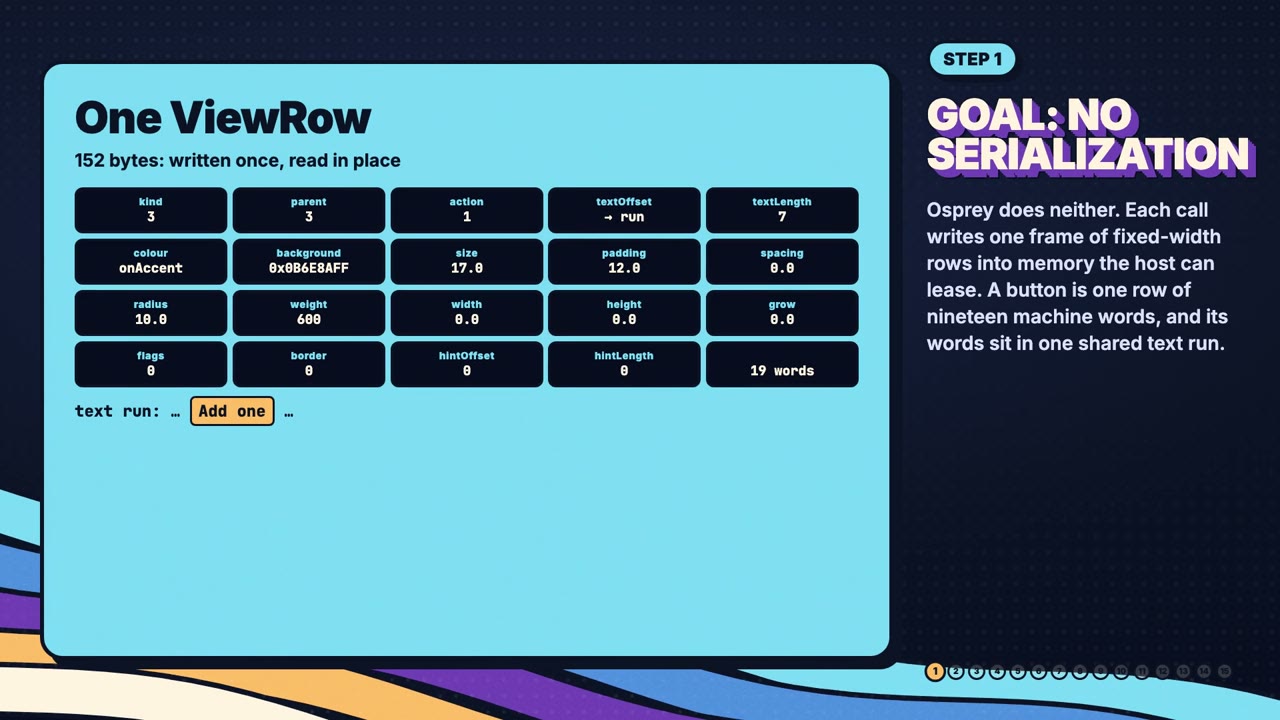
The builtin nativeViewRow calls osp_native_view_row, one function in the C runtime (native_bridge.h). It appends one 152-byte row to the pending view run and copies the row's text once into the text run. It returns the new row's index so that children can name it as their parent. It refuses the frame, and returns -1, when a number is not finite, an extent is negative or a parent is not an earlier row. A static_assert checks the C struct against the generated layout:
_Static_assert(sizeof(OspNativeView) == sizeof(td_ViewRow) &&
                   offsetof(OspNativeView, text_offset) == TD_ViewRow_textOffset_OFFSET &&
                   offsetof(OspNativeView, size) == TD_ViewRow_size_OFFSET && …,
               "OspNativeView matches the generated ViewRow layout");
Component apps use the same rows. A component tree is told as three more row kinds: 33 field for one named value, 34 record and 35 list. Each row names its parent, so a host rebuilds the typed tree and draws it with its own controls.
The host commits, leases and reads
When an export returns, the host calls osp_native_frame_commit. That call takes all four pending runs in one step, seals them in place and publishes them as one frame with a new revision. No row can land half in one frame and half in the next.
The host then reads the frame:
osp_native_acquiretakes the root lease of the newest frame.osp_native_childtakes one lease for each of the four runs.osp_native_lengthreturns each run's length in bytes.osp_native_viewreturns a pointer into a run, after checking the lease, the chunk's type and that the requested range lies inside the chunk.
A lease is an owner token that names the app instance, the allocation, its reuse generation and the byte offset. A stale, forged, foreign or double-released lease is refused as a typed BridgeError and never followed. Memory is freed only when its last lease is released. The host releases the previous frame only after it holds the next one, so memory being drawn is never changed or freed underneath it.
The host trusts nothing the app wrote. Before it draws anything, it checks:
- every kind and scene code is one it knows;
- every parent is an earlier row;
- every float is finite;
- every text range lies inside the text run, on UTF-8 boundaries;
- every count stays inside the rows that follow it.
A frame that fails any check is refused whole, and the host keeps showing the last good frame.
How each host speaks the bridge
The bridge's storage, leases and checks are written once, in C, in the Osprey runtime that each app library links. Each host reads the same frame in its own language, from structs that mirror the generated layout.
flowchart LR
  TD[native.td] --> H[native_abi.h<br/>offsets and fingerprint]
  H --> C[C runtime bridge<br/>in every app library]
  C --> S[SwiftUI host<br/>macOS and iOS]
  C --> G[GPUI host<br/>Rust, macOS and Android]
  C --> W[WinUI host<br/>C#, Windows DLL]
  C --> K[Android host<br/>JNI and Kotlin]
  C --> V[VS Code webview<br/>wasm32 in a worker]
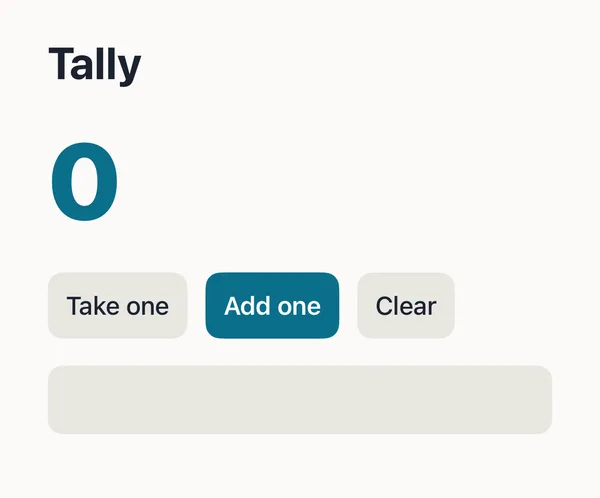
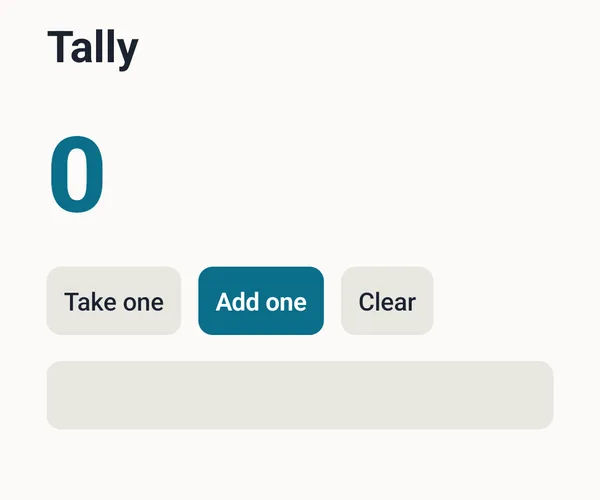
Both captures are Tally's committed view-check goldens. Neither host holds a style of its own: the colours, sizes and spacing are the values in the rows, so the two screens match.
macOS and iOS: SwiftUI
The SwiftUI host links the app's static archive. Both the Mac and the iPhone use the same OspreyShared library. SharedBridge.swift opens the bridge with a random 16-byte instance identity and TD_SHARED_FINGERPRINT, so a pointer from another launch is refused. After each call, it commits the frame and leases the four runs. It hands SharedRows.read the rows as UnsafeBufferPointer<OspNativeView>, typed views straight over the bridge's bytes. SharedRows checks the rows and copies them into Swift values, then the host releases every lease before the call returns. SwiftUI draws from those values: stacks, buttons, text fields and SF Symbols.
Windows: WinUI
On Windows the app is a DLL. It exports osprey_native_bridge, a table of twelve function pointers that the WinUI host calls through C# delegate* unmanaged pointers (Bridge.cs). The rows are [StructLayout(LayoutKind.Sequential)] readonly structs with the same fields as the C structs. The host's fingerprint is a literal in Bridge.cs, and a test reads native_abi.h from the repository and fails as soon as the two differ. The host draws with WinUI controls and Segoe Fluent Icons, inside an AppContainer.
GPU canvas: GPUI
The GPUI host is Rust. frame.rs declares #[repr(C)] structs and asserts their sizes at compile time: 88, 152 and 32 bytes. A leased frame is an Arc<Frame> whose runs are &[ViewRow] slices made with slice::from_raw_parts over the bridge's bytes; no row is copied. The painter can hold an older frame while newer ones are published. Drop releases the leases when the last holder lets go. rows.rs checks every row first.
Android
The Android host is a JNI library, bridge.c, which owns the bridge and calls the exports on the host thread. It hands Kotlin the four runs as NewDirectByteBuffers over the leased bytes, so Kotlin reads the app's memory without a copy. Rows.kt checks every row, Android views draw them, and every lease is released once Kotlin has read the frame.
VS Code and the web: WebAssembly
The webview host runs the app's wasm32 build in one worker per panel (wasi-worker.ts). The module exports the three calls and the bridge entries over its own linear memory, laid out by the same header under its wasm32 fingerprint. The worker reads 64-bit fields with getBigInt64, never as a JavaScript number, so no value above 253 loses precision. It copies the four runs out of linear memory once and passes them to the webview. rows.ts reads them with a DataView at the generated offsets, under the same checks as the native hosts.
The smallest host
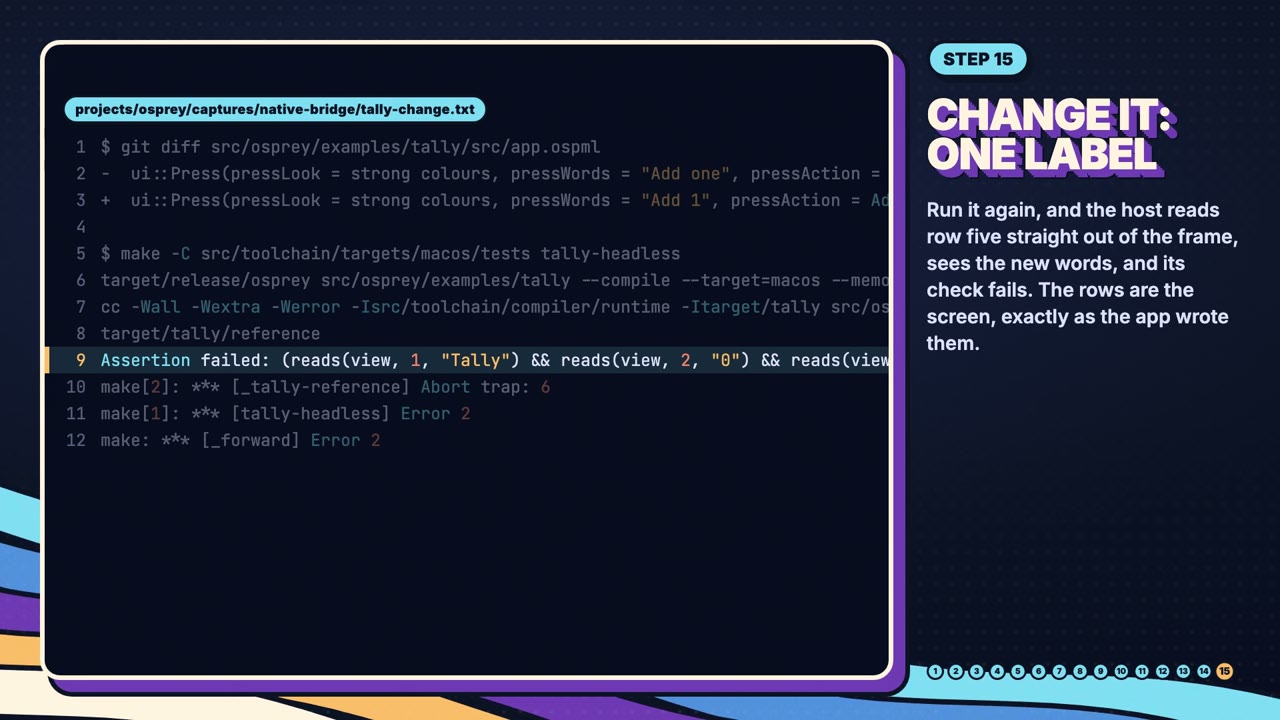
reference.c is a complete host with no UI toolkit. It is also Tally's end-to-end test. It opens Tally, presses its buttons by control number, and asserts the kind, parent, action and words of every row it reads in place.
Events come back as typed calls
A person's input returns as one osprey_app_event call: a kind, the control it names, two texts, two numbers and two flags. The kinds are:
- 0: a control delivered its words;
- 1 to 3: a key, a pointer, or a scene's measured size;
- 4 to 7: board strokes and lassos;
- 8: a capability completed;
- 9: a lifecycle phase;
- 10: a display frame;
- 11: an appearance change.
The framework numbers each control that delivers an action, in drawing order, and keeps the actions inside the library. A control event names a number. The app looks the number up in a list it wrote itself and checks the value's kind. An unknown number or the wrong value kind is refused: the app draws the same screen again, with the reason as a diagnostic ask. The host can never construct an action, and a control number is never an authorization token.
Capability requests travel the other way as ask rows: reading files, running processes, network requests, storage. A host answers the requests it supports and completes each with one completed event. It refuses every code it does not know with a diagnostic that names it.
Why not a JSON bridge?
Imagine the same boundary built the way many UI bridges are built: the app encodes its screen as JSON, the host parses it, and events come back as JSON too. One button might look like this:
{"kind":"press","parent":3,"action":1,"text":"Add one",
 "look":{"ink":"#FFFFFFFF","fill":"#2F6FEBFF","size":17.0,"padding":12.0,"radius":10.0,"weight":600}}
Every frame would pay for that text twice, once to write it and once to read it. Osprey's bridge writes the same button as one 152-byte row and the host reads it where it lies.
| A hypothetical JSON bridge | The shared-memory bridge | |
|---|---|---|
| Writing a control | Build objects, format every number as decimal text, escape every string | Write 19 machine words, copy the text once |
| Reading a control | Tokenize, allocate a dictionary per node, convert text back to numbers | Read a field at a known offset |
| Intermediate trees | One on each side, per frame | None between the rows and the host's own controls |
| Garbage | Strings and maps every frame, on both sides | A frame is four runs and one branch chunk |
| Type agreement | Each host's parser and the app must agree by convention; a renamed key fails silently or at runtime | One native.td; a layout mismatch is refused at startup by its fingerprint |
| Numbers | JavaScript reads JSON numbers as doubles; 64-bit values above 253 lose precision | Fixed int64 and float64 fields; JavaScript reads them as bigint |
| A malformed message | Partly parsed, partly applied, or a guessed default | Refused whole; the last good frame stays |
| State | Tempting to send the whole model across and back | The state never leaves the library |
Why shared memory is better than serialization
- No formatting work. Serialization converts values to text and back. For a UI that redraws on every event and every display frame, that conversion is pure overhead. Shared rows are already in the form the host reads.
- One copy of the text. Each string is copied once into the text run. The host borrows it in place, or copies it once into its own toolkit.
- Constant-time access. A host reaches row n at offset n × 152. A parser has to read everything before row n to find it.
- Checked types, not conventions. The layout is generated from one schema and fingerprinted. A host built for a different layout cannot open the bridge at all.
- Bounded and fallible. Budgets for bytes, chunks and owners are fixed when the bridge opens. A failed allocation refuses the frame; it never produces an empty successful frame.
- Safe sharing. Frames are immutable once sealed and reference counted through leases, so a GPU painter can draw one frame while the app writes the next.
"Shared memory" here means memory shared between the app and its host inside one process. It is ordinary heap memory that the bridge owns, outside the GC and ARC heaps. The bridge creates no operating-system shared-memory object, file mapping, socket or named handle, so no other process gets anything to attach to.
Speed follows from the design. Flock streams thousands of birds as scene rows: 5,000 sprites cost about 7 ms a frame, update included. The framework's per-frame cost is measured by src/toolchain/hosts/gpui/bench and recorded in plan 0037.
Where text formats still appear
Text crosses in three places only:
- the result text of a capability completion;
- the contents of host-held slices that capability adapters fill;
- the VS Code webview's one copy of the raw rows across its process boundary, which is still rows, not a text format.
Formats owned by the outside world, such as HTTP bodies, stay inside the adapter that speaks them.
Safety rules, in short
- Frames are immutable once sealed, and every read goes through a lease.
- Every read is bounds checked by the bridge, and every row is checked again by the host.
- A failed call or a refused frame publishes nothing.
- The C bridge's tests run under both memory backends. They cover stale leases, exhausted limits, allocation failure at each step, publication, synchronization failure, concurrent readers and writers, and refused values (
host_import_tests.c).
Host coverage varies by app. The host conformance suite, one fixture set that drives every host through this boundary, is still delivery work in plan 0037. Osprey is actively evolving; validate it against your workload.
Osprey Native → · Tally, the sample app · Host contract · The schema
- Every Osprey Native app reaches its screen through one bridge. SwiftUI on the Mac and iPhone, WinUI on Windows, GPUI on the GPU, Android, and the VS Code webview all read the same frame. Here's how it works, in the code.
- First, imagine the usual way to build a bridge. The app turns its whole screen into JSON text: every button becomes an object, every colour and size a decimal string.
- The host then parses that text, allocates a dictionary per node, converts the numbers back, and hopes every key still means what it did. Every frame pays twice: once to write the text, once to read it.
- Osprey does neither. Each call writes one frame of fixed-width rows into memory the host can lease. A button is one row of nineteen machine words, and its words sit in one shared text run.
- The host checks each row and reads it where it lies. Nothing is formatted, and nothing is parsed.
- It starts with one model, written in typeDiagram, in native.td. A ViewRow is one control: its kind, the earlier row that is its parent, and the action a tap delivers.
- Text is never a pointer. A row names an offset and a length into the frame's one UTF-8 text run.
- Every colour, size, space and flag is already decided in Osprey. The host applies them, and holds no style of its own.
- Capability requests ride in the same frame as ask rows: four fields each, with arguments in the rows that follow.
- typeDiagram generates native_abi.h, the header every host builds against. It carries a fingerprint of the whole layout, one for sixty-four-bit hosts and one for wasm32. A host built for a different layout cannot even open the bridge.
- It also names the offset of every field. Each row is little-endian, eight-byte aligned, and the same width on every host: a ViewRow is a hundred and fifty-two bytes.
- Here is Tally, the sample app. Every app exports the same three calls: argument, open and event. Each one writes a whole frame and returns a status.
- Shown renders the screen into the frame, and keeps the store, with the actions its controls deliver, inside the library. The state never crosses the bridge.
- When an event names a control, Tally looks its number up in the list it wrote itself. An unknown number is refused, and the same screen is drawn again.
- Rendering performs an effect for each control. Views::shared handles it by calling osp_native_view_row, which appends one row straight into the frame.
- Capability asks go the same way, through osp_native_ask.
- And because it's an effect, a test can swap the handler. Views::quiet drops every row, so the same rendering code runs with no host at all.
- On the other side of that call is the C runtime that every app library links. osp_native_view_row copies the text once, and returns the row's index for its children. A number that is not finite, or a parent that is not an earlier row, refuses the frame.
- A static assert ties the C struct to the generated layout, so the runtime cannot drift from the model without failing to compile.
- When an export returns, the host calls osp_native_frame_commit. It takes all four pending runs in one step, so no row can land half in one frame and half in the next.
- It seals the runs in place, and joins them under one branch chunk: scene rows, view rows, text, and ask rows.
- Then it publishes the frame with a new revision. A committed frame never changes again.
- The host reaches that memory only through a lease: an owner token naming the app instance, the allocation and its reuse generation. A stale, forged or double-released lease is refused as a typed error.
- osp_native_view checks the chunk's type, and that the requested range lies inside it.
- Only then does it hand back a pointer to the bytes, in place. No copy is made.
- Now the hosts. The SwiftUI host, on macOS and iOS, runs the export, then commits the frame it wrote.
- It leases the four runs, and the defer releases every lease before the call returns, so no pointer outlives its lease.
- SharedRows reads the rows as typed buffers over the bridge's own bytes, checks every one, and builds the values SwiftUI draws.
- The GPUI host is Rust. Its rows are repr(C) structs, and the compiler asserts their sizes: eighty-eight, a hundred and fifty-two, and thirty-two bytes.
- A run becomes a slice with from_raw_parts, straight over the leased memory. The painter can hold one frame in an Arc while the next is written, and the lease goes when the last holder drops it.
- On Windows, the app is a DLL, and WinUI reads the same rows as sequential C# structs, field for field.
- The fingerprint is a literal here, and a test reads native_abi.h from the repository and fails the moment the two differ.
- On Android, a small JNI library owns the bridge and calls the exports on the host thread.
- It hands Kotlin each run as a NewDirectByteBuffer over the leased bytes, so Kotlin reads the app's memory without copying it.
- In VS Code, the same app is a wasm32 module in a worker. The worker calls the same bridge entries over the module's linear memory, and reads sixty-four-bit fields with getBigInt64, so no value silently loses precision.
- It checks that each run lies inside linear memory, then copies the raw rows once, across to the webview. Even there, what crosses is rows, not text.
- Input comes back the other way as one typed call. A control event is kind zero, the control's number and its words: just numbers and borrowed text.
- The reference host proves the refusals: a control that was never drawn, a negative number, or a kind Tally does not take. Each returns one, and the same screen comes back.
- Let's run it. The tally-headless target compiles Tally to a C library and links it under this reference host, with no UI toolkit at all.
- It drives every control and reads thirteen views in place from shared memory. It passes.
- Now one change. In Tally's view, the Add one button becomes Add one, written as a digit.
- Run it again, and the host reads row five straight out of the frame, sees the new words, and its check fails. The rows are the screen, exactly as the app wrote them.
- One model, one frame of rows, and five hosts reading it in place. Read the full guide at ospreylang.dev, under Osprey Native, and try Tally on your machine.