Package manager
The package client, folder-registry server, manifest parser, resolver, digests and tests are written in Osprey. Platform operations use the existing runtime builtins; the current filesystem and process handlers invoke POSIX find, mkdir and shell redirection. Windows host support is not established. The implementation contract requires the package-system logic to remain Osprey source.
The contracts cover manifests and commands, trust services, the domain model and verification evidence.
Add and remove packages in VS Code
Browse the registry, inspect a release, add a package and remove it from your project in the package workspace. The video shows all 19 available packages and the actual confirmation and installation screens.
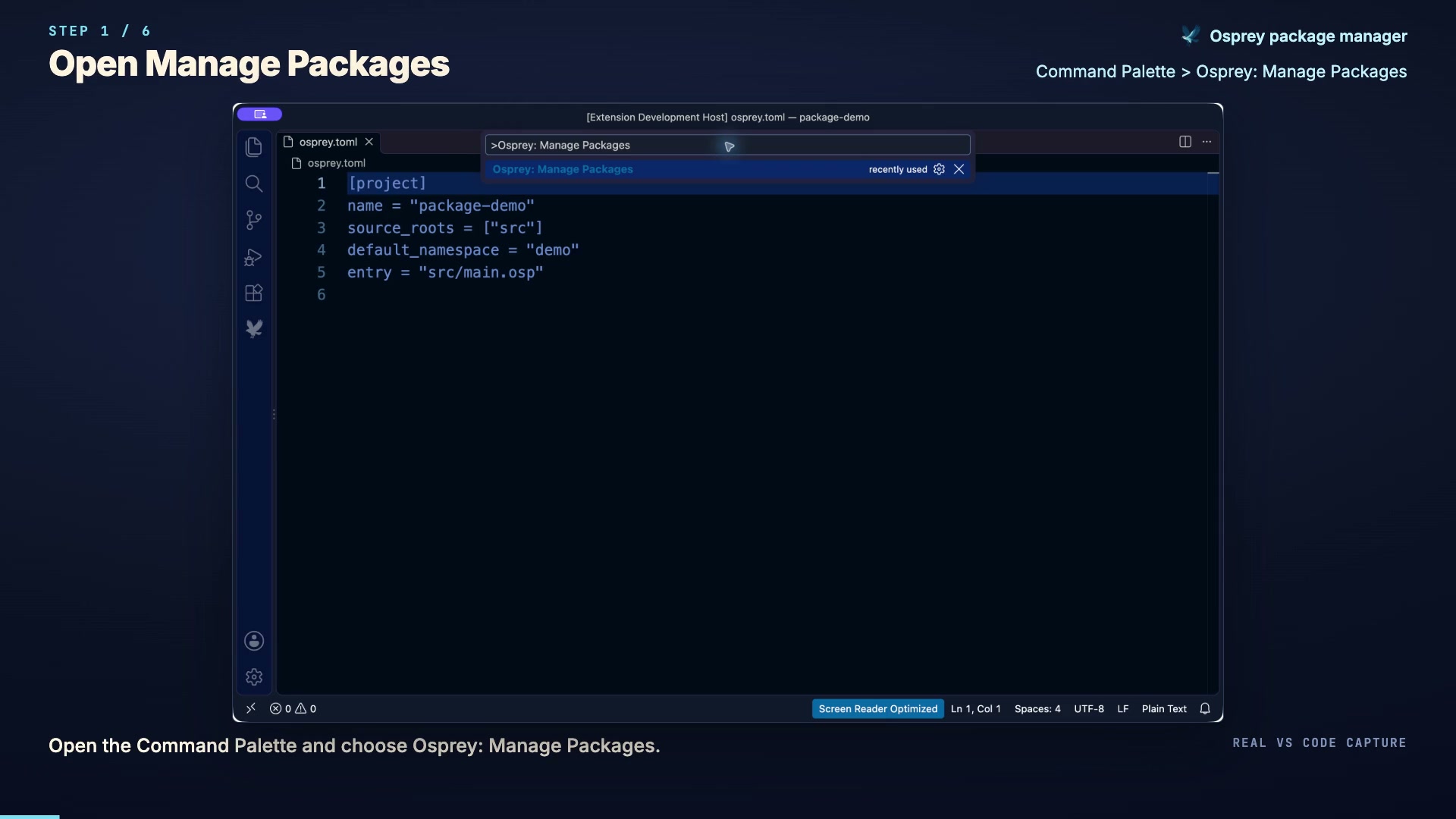
Follow Packages in VS Code for the screenshots and step-by-step instructions. The registry connection is already configured in the video.
Get started with the working registry
The folder registry and package client run today. The public package website, hosted publishing and trust services are planned; you do not need them to try packages locally or run a private registry.
From the Osprey repository root, build the toolchain and the package client:
make build
./target/release/osprey build packages/manager/cli -o target/osprey-pkg
make registry-serve
Leave the server running. In another terminal at the repository root, resolve and build the sample consumer, which already declares its dependency on @demo/report:
echo "lock --project $PWD/packages/manager/e2e/consumer --registry http://127.0.0.1:8787" | ./target/osprey-pkg
echo "fetch --project $PWD/packages/manager/e2e/consumer --registry http://127.0.0.1:8787" | ./target/osprey-pkg
echo "verify --offline --project $PWD/packages/manager/e2e/consumer" | ./target/osprey-pkg
echo "build --run --compiler $PWD/target/release/osprey --project $PWD/packages/manager/e2e/consumer" | ./target/osprey-pkg
--compiler selects the compiler just built; otherwise build uses osprey on PATH. Each command prints status: N; check that it is 0. The frontend currently reads one command from stdin and cannot set a process exit status. It splits the command on whitespace; paths containing spaces are not supported by this entry point. For your own project, create an osprey.toml, declare dependencies as below, and use its absolute directory with --project. The command table describes package init, add and local checkout overrides.
How the package website will work
The package manager has its own website in the planned public service. The language website keeps this guide: installation, manifests, commands and how dependencies become part of an Osprey build. The package website is where you will discover libraries and inspect a particular release before choosing it.
| Surface | Responsibility |
|---|---|
| Language documentation | Teach the package workflow and link to package discovery. |
| Package website (planned) | Search and package pages with source, dependencies, effects and capabilities, release history, advisories and verification evidence; authenticated publishing and ownership workflows. |
| Registry API | Supply package metadata and digest-addressed source to the website and command-line client. Today's folder server implements the public-read subset listed below. |
| Local client | Resolve dependencies, verify downloaded source, write locks and build from installed packages. |
The intended workflow is: find a package on the package website, review its API and required capabilities, copy its scoped key and epoch into your project, then use the client to lock and fetch the exact releases. Browsing selects what you want; your manifest, lock and client verification determine what you build. Once the locked trees are installed, ordinary builds and runs work offline without the website.
The browser application is planned as Osprey compiled to WebAssembly, using the same versioned Osprey API as the client. Supabase will provide hosted Postgres, authentication and storage behind that API; clients will verify releases and trust proofs rather than treating the database or website as the authority. The database-free folder registry remains supported for private networks and self-hosting.
Public publishing is planned around a signed intent naming a forge repository and commit: the registry will assemble and verify the source itself. Today, use publish --folder <registry-root> and restart the folder server to expose the new release. Public login, signed publication, search, evidence pages and the hosted website are not available yet. Plan 0020 tracks those delivery stages.
Resolve, fetch, then build offline
flowchart LR
  M["osprey.toml<br/>epochs and floors"] -->|lock| S["one CDCL solver"]
  R[("folder registry<br/>GET /v1/…")] -->|candidates| S
  S -->|writes| L["osprey.lock<br/>RFC 8785 canonical JSON"]
  L -->|fetch| P["installed trees<br/>verified by SourceDigest"]
  P -->|verify --offline| V["manifest, edges and<br/>every digest agree"]
  V -->|build --run| C["Osprey compiler<br/>packages as source roots"]
lock selects exact releases through the solver. fetch downloads their source. After installation, verify --offline, build and build --run verify the lock and installed trees without registry access. The application started by build --run may still use the network. Each verification step re-derives its digests.
A registry is a folder
A registry needs no account, no database and no hosted service. It is a directory where each release is a folder named after the package and its release identity:
my-registry/
  @demo/
    maths/
      1.1/        osprey.toml, src/...
      1.2/
    greeting/
      1.1/
    report/
      1.1/        depends on @demo/maths and @demo/greeting
Epochs and release ordinals both start at 1.
The Osprey server walks that root, validates every release against the canonical source rules, computes each release's SourceDigest, and serves the catalog over HTTP:
make registry-serve          # serves packages/manager/sample-registry on http://127.0.0.1:8787
curl http://127.0.0.1:8787/v1/packages
curl http://127.0.0.1:8787/v1/packages/demo/maths| Endpoint | Returns |
|---|---|
GET /v1/health |
liveness |
GET /v1/packages |
every package key with its releases |
GET /v1/packages/{scope}/{name} |
the releases of one key, ordered by epoch and ordinal |
GET /v1/releases/{digest} |
one release's identity and manifest digest |
GET /v1/releases/{digest}/source |
the canonical JSON source bundle |
Every response carries a digest ETag; errors are application/problem+json. A release directory that breaks a rule (a symlink, an executable bit, a case-fold collision, an LFS pointer, a path outside the ASCII grammar) is refused at startup with a stable reason code and never served.
To serve your own folder on your network, edit packages/manager/api/registry-server.json and run the server:
{ "root": "/srv/osprey-packages", "address": "0.0.0.0", "port": 8787 }The client verifies every byte
The client downloads a release's canonical source bundle, recomputes its SourceDigest and compares it with the identity it asked for before writing a single file. A tampered bundle, a wrong key, a missing release or an unreachable registry each fail with their own stable code.
echo "fetch @demo/report --registry http://127.0.0.1:8787" | ./target/osprey-pkgThe release lands in .osprey/packages/@demo/report/<digest>/. You can also fetch by epoch (fetch @demo/report@e1) or directly by digest (fetch sha256:…). The folder registry proves integrity: the bytes you build are the bytes the server holds. It does not yet prove who published them; that is the trust plane of Milestone B, described below.
The client reads one command line from standard input and prints status: N as its last line, because Osprey has no argument-vector or exit-status builtin yet. Those are recorded as blocked host capabilities, not design choices.
No SemVer
Osprey releases use epochs and ordinals rather than SemVer strings. A package key such as @osprey/http has a sequence of releases, each identified by an epoch and an ordinal:
- An epoch is a compatibility lineage. Every release inside an epoch is an additive contract over the ones before it: code written against
@osprey/httpepoch 2 release 17 keeps compiling and keeps its meaning on release 18. A breaking change starts a new epoch. - An ordinal counts releases inside an epoch. It only grows.
A dependency names one epoch and a floor:
[dependencies]
"@osprey/http" = { epoch = 2, min_release = 17 }
min_release = 0 accepts any release in the epoch. There are no upper bounds, no ranges, no caret or tilde, no pre-release tags and no version strings in Osprey release identities. Python interop projects retain the separate version fields uv requires. Peer dependencies, optional features, Git URLs, branches and published path dependencies are rejected by the manifest rules with the line and column of the offending key. This keeps the resolver's job honest: for every package key exactly one release is selected, from exactly one epoch, and it is the one the whole graph can agree on.
The manifest
osprey.toml is the only manifest. The [project] table is what the compiler already reads; the package tables sit beside it:
[project]
name = "ledger"
source_roots = ["src"]

[package]
name = "@finch/ledger"
license = "Apache-2.0"
summary = "Immutable ledger primitives"
keywords = ["ledger", "transactions"]

[dependencies]
"@osprey/http" = { epoch = 2, min_release = 17 }

[system.sqlite]
capability = "sqlite/c-api"
min_revision = 3045000
The parser is a strict TOML subset written in Osprey: tables, arrays of tables, dotted and quoted keys, inline tables, integers, strings and booleans. Floats, dates and non-ASCII text are rejected with located codes. Names are scoped ASCII, licenses are SPDX expressions, source roots are checked for duplicates and case-fold collisions, and every unknown table or key is an error before anything is hashed. A spec example round-trips to its canonical JSON and manifest digest byte for byte.
A published package may be written in Osprey's Python flavor: [project].python_sources lists its .py files, each beginning with # osprey: flavor=python, inside a source root. The list is part of the canonical manifest, the marker is checked on every file of a release tree (source.python-flavor-header), and the Osprey compiler reads those files as Osprey source. Python-flavor .py files are compiled by Osprey rather than run by CPython, so ports such as @osprey/numpy publish exactly like any other package.
Locked builds work with Default and Python-flavor sources. The client writes its derived compiler project under the selected project's .osprey/build/, with source paths relative to that manifest. On 25 October 2026, real compiler checks passed for both flavors: bare build, build --run, and builds selected by relative or absolute --project paths from another directory. These checks do not establish cross-platform host support.
Package publication automatically retains root LICENSE, COPYING, NOTICE, AUTHORS and THIRD_PARTY_NOTICES files (including .txt/.md forms) and the complete LICENSES/ directory. These documents are included in the release digest and remain after fetch/install. The package license audit distinguishes API-only Osprey implementations from specifically copied or adapted source and data. Original Osprey contributions carry MIT; identified reused material retains its applicable terms and notices. Compiled application distributions must supply the applicable documents too.
A system capability names something the operating system provides, such as SQLite's C API. The hosted design maps capabilities to signed, approved providers; that provider catalog is not implemented. Today, osprey-pkg doctor prints system-capability guidance and host blockers. Osprey never downloads a native component and never invokes Homebrew, apt or any installer.
Resolution
Resolution is one deterministic solver, with no greedy fallback and no "good enough" path. The engine is a conflict-driven clause-learning SAT solver written in Osprey: two watched literals per clause, first-unique-implication-point learning, deterministic decisions, a proof trace of every learned clause, and a core of the input clauses behind an unsatisfiable result. The package layer builds hard clauses for root requirements, each candidate's own edges, one release per key across all epochs, and an acyclic package graph, then minimises a lexicographic cost tuple exactly in the order the spec fixes: changed releases against the current lock first, then package count, then technical lag, with the canonical graph vector as the final tie-break.
An unsatisfiable graph is explained deterministically, with a stable code and the package keys it concerns: resolution.epoch-conflict names the keys that demand two epochs, resolution.cycle names the ring, resolution.missing-package names the key no release satisfies, resolution.capability names the key whose ambient capability the root did not grant. The packages an explanation names come from the solver's own proof: every hard clause records the package keys it is about, the UNSAT core behind the refutation is minimised by deletion until no clause can be dropped, and the explanation is chosen, in the order the spec fixes, among the causes that hold for the keys that minimal core mentions. The exhaustive test oracle shares candidate and explanation helpers with the resolver; it checks the search and optimum independently, rather than independently deriving the conflict core. The same inputs in any order produce the same lock and the same explanation, and an independent exhaustive oracle in the test suite agrees with the solver on every bounded fixture.
Locks
Until the trust plane exists, the client writes osprey.lock in folder-lock format 0, as RFC 8785 canonical JSON:
{"format":0,"packages":[{"dependencies":[...],"release":{...}}],"root":{"dependencies":[...],"manifestDigest":"sha256:..."}}It pins the root manifest's digest and dependency edges, and for every selected release its identity (key, epoch, ordinal and SourceDigest), edges and capability surface. Graphs declaring Python interop also pin the generated Python project and uv lock under root.python. Three rules follow from it:
osprey-pkg lockconsults the registry, runs the solver and prints+,=,~and-deltas.add,remove,updateandusealso invoke relocking.osprey-pkg fetchinstalls every locked release, skipping a tree whose digest already matches.osprey-pkg verify --offlineand build preparation never resolve or fetch. They fail when the manifest digest differs from the lock, when the dependency edges differ, when a locked release is not installed, or when an installed tree's digest no longer matches.
build compiles the project through the existing compiler with the installed packages as source roots. build --run then executes your program, whose own effects may use the network; there is no standalone package-client run command. Osprey packages have no install hooks or build scripts. Packages declaring Python interop also use the separate uv environment described below.
Local manifest/lock updates roll back on a reported relock failure. Crash-safe activation is still blocked on atomic rename and fsync support; rollback is not a durable filesystem transaction.
Commands
| Command | What it does |
|---|---|
help |
the command surface |
--json <command> … |
any command's report as one canonical JSON line, {"lines":[…],"status":N}, for editors and automation |
doctor |
the blocked host capabilities and system-capability guidance |
package init [--name <project>] |
write the smallest accepted osprey.toml where none exists |
add @scope/name [--epoch N] |
pick the key's newest epoch (or the lineage you name) and its newest release as the floor, write the dependency line and relock; the previous manifest is restored if relocking fails |
add <path> [--epoch N] |
declare the checkout's package key with its published baseline as the floor (zero when unpublished), relock the release lock when a baseline exists, then map the checkout and relock the development lock |
remove @scope/name |
drop the dependency line and relock, printing the - lines |
use <path> [--epoch N], use @scope/name --published, use --list, use --clear |
develop against a local checkout: the mapping goes into osprey.local.toml, osprey.local.lock is relocked with the checkout in place of every published candidate of that key, and [dependencies] is never rewritten |
lock --local |
relock the development lock after a local manifest change; plain lock never sees the overlay |
build --release |
refuse while any override is active, then build from osprey.lock |
update [--breaking] |
relock without the current choices being sticky, so every key moves to its epoch's newest release; --breaking first moves each dependency with a newer epoch to it and prints one epoch @scope/name eN -> eM line per change |
fetch @scope/name[@e<epoch>], fetch <digest> |
download, verify and install one release |
fetch |
install every release in osprey.lock |
lock [--registry <url>] [--accept-removals] |
list the registry once, fetch and verify every release, resolve [dependencies] and write osprey.lock, printing +, =, ~ and - per package; refuses, writing nothing, a re-served digest (lock.release-replaced), a dropped locked release (lock.release-vanished, unless --accept-removals) and a current lock that does not decode |
verify --offline |
check manifest, lock and installed trees without the network |
build [--run] [--compiler <path>] |
verify, then compile (and run) through the selected compiler; defaults to osprey on PATH |
tree |
the locked graph as an indented tree, (build) on build edges, * on a key already shown |
why @scope/name |
every chain of edges from your project to that locked package, one line each |
publish --folder <registry-root> [--breaking] |
place this project as the next release of a folder registry, checked and digested exactly as the server will; the server reads the folder at startup |
audit, yank, login |
specified in spec 0029; answered with a "not yet implemented" status today |
Python and uv
The Osprey resolver selects Osprey releases. Programs using Python interop resolve and lock their CPython dependencies through uv:
- A package that needs Python declares
[system.python]withcapability = "python/interop"and a CPython floor, and ships an ordinarypyproject.tomlanduv.lockin its root. Both are part of itsSourceDigestlike any other file. osprey-pkg lockgenerates one uv project under.osprey/python/that depends by path on the root and on every installed release that declares the capability, runsuv lockso uv resolves the union of their Python requirements, and pins the digests of the generated project and ofuv.lockinsideosprey.lock.osprey-pkg fetchrunsuv sync --frozento create the environment.verifyandbuild(includingbuild --run) regenerate the project, compare digests and runuv lock --check --offline; they never sync and never go online. Their codes arepython.pyproject-missing,python.uv-lock-missing,python.workspace-digest,python.uv-lock-staleandpython.environment-missing; a uv command that fails ispython.uv-lock-failedorpython.uv-sync-failedwith its exit status. A failed uv operation prevents writing the new Osprey lock; generated Python workspace files may already exist.- A graph with no member declaring the capability has no
root.pythonin its lock, gets no generated project and never runs uv.
Osprey never installs uv or CPython; osprey-pkg doctor reports where uv is, or that it is missing and needed only by packages declaring python/interop. The Python flavor needs none of this: it is Osprey source with no Python dependency.
Supply-chain controls and remaining work
Spec 0029 [PACKAGE-THREATS] defines the threat model. The folder registry implements source validation, digest verification and capability checks; authenticated publication and public trust proofs remain Milestone B work. These controls do not establish that a dependency is benign.
| Threat | Control and delivery status |
|---|---|
| Malicious code inside a dependency | Ambient capability checks. lock scans named ambient builtins and declared system capabilities, requires the root's io/… grants per dependency, and pins the surface in the lock. Grants are not transitive. fetch, verify --offline and build recompute the surface and reject a mismatch with capability.surface. Source scanning marks raw native declarations as unclassified in all three syntax flavors; bundle validation and local publish --folder reject them before registry writes. These checks do not establish complete runtime confinement of untrusted packages. |
| Install-time code execution | Osprey source packages have no lifecycle hooks, build scripts or post-install step. Python interop delegates environment creation to uv sync --frozen; the Osprey source-only guarantee does not cover Python dependency installation. |
| Publisher-supplied archives | Milestone B: the registry will derive releases from bound forge commits. Today, publish --folder validates a local source tree and places it in the registry folder; it does not authenticate a forge commit. |
| Tampered or substituted bytes | A release is its canonical SourceDigest. The client recomputes it before writing a single file; a lock pins it; build refuses a tree whose digest drifted. |
| Floating versions | A dependency names an epoch and a floor; the lock pins exact releases. build, including build --run, never resolves dependencies. |
| Dependency confusion and typosquatting | One canonical scoped key per package, exactly one source per key in every graph, published path and Git dependencies rejected, Unicode confusables and case-fold collisions refused by the name and path grammars. |
| Native binaries and installers | Native needs are declared system capabilities; doctor reports guidance. Approved provider catalogs are planned. Osprey never downloads a native binary or invokes an OS package installer. |
| Compromised registry, mirror or CDN | Milestone B: a TUF 1.0 trust root with 3-of-5 offline keys, 2-of-3 release roles, consistent snapshots, expiry and version floors, so no single online component can make a client accept unauthorized, rolled-back, frozen, expired or substituted source. |
| Silent history rewriting | Milestone B: every publication, yank, revocation and build is an in-toto attestation in an append-only transparency log with inclusion and consistency proofs, witnessed by a 3-of-4 quorum. |
| Unreproducible builds | Milestone B: two separately administered hermetic SLSA Build L3 platforms must produce bit-identical results before anything is published, with SPDX SBOMs and provenance attached. |
| Revoked or yanked releases | Milestone B: a monotonic signed status chain. Cached locks will survive a yank; a known revocation will block every build and activation except isolated audit reproduction. |
| Local overrides leaking into releases | Development overlays live in separate files and locks; build --release fails on any override, duplicate key or unpinned input. |
Today's folder registry verifies source integrity, pins releases, checks capability surfaces and enforces one source per key. It does not yet prove who published a release or how fresh the catalog is. The trust services in spec 0030, compromise simulations and independent security audit are delivery requirements, not completed assurances.
Input validation and current limits
Spec 0029 [PACKAGE-HARDENING] defines validation gates with stable diagnostic codes, asserted by name in registry tests.
Server. A response is a pure function of method, path and the catalog built at startup, so no request can reach the filesystem or a process. Anything but GET is 405 with Allow: GET; traversal, percent-encoded and malformed paths are 404 problems that never echo request bytes. Every response carries X-Content-Type-Options: nosniff, Content-Security-Policy: default-src 'none' and Referrer-Policy: no-referrer; digest-addressed responses are Cache-Control: public, max-age=31536000, immutable, everything else no-cache. The runtime bounds a request to 1 MiB, its headers to 32 KiB and its arrival to 5 seconds. Beyond loopback, the registry sits behind a TLS-terminating, rate-limiting reverse proxy.
Client. Every fetched body passes, in order: a 128 MiB size bound, strict JSON (depth 64, duplicate keys, bad surrogates, control bytes), the bundle shape, the path grammar of every entry (absolute paths, .., backslashes, device names, case collisions), the file-kind gate, the 10,000-file and 50 MiB limits, and finally the recomputed SourceDigest against both the bundle's claim and the digest that was asked for. Only then does a directory get created, and its name is built from the verified identity, never from a listing row, a lock line or a command-line word. The lock decoder applies the same name and digest grammars (lock.shape). Lock-based fetch, verify and build never resolve or read a listing; fetching a package by name consults the listing to select a release; a lock edited without its manifest stops build before the compiler starts. lock refuses a registry that serves a different digest for a locked release (lock.release-replaced) or drops one (lock.release-vanished). Printed lines are sanitized so no server string can carry a terminal escape. The client follows no redirects and reads no credentials from locks or manifests.
Python plane. The generated pyproject.toml pins index-strategy = "first-index" and declares no index; an interop tree may not add indexes (python.index-forbidden) or git, url or outside-path sources (python.source-forbidden); uv.lock must carry a hash for every distribution or lock refuses it (python.uv-lock-hashes); sync is uv sync --frozen. Each rule stops lock before uv runs or before the folder lock is written.
Disclosure. SECURITY.md at the repository root says how to report privately and what the response target is.
| Probe | Answer |
|---|---|
POST, PUT, DELETE, HEAD on any route |
405, Allow: GET |
/v1/releases/../../etc/passwd/source, %2e%2e, %40scope |
404 from the catalog alone |
Bundle path ../x, /etc/x, a\b, CON, A.osp beside a.osp |
path.* before any write |
| Bundle over 128 MiB, 10,001 files, 50 MiB + 1 of content | bundle.too-large, source.too-many-files, source.too-large |
| Bundle claiming another digest, or with altered bytes | bundle.unexpected-digest, bundle.digest-mismatch |
Lock with "scope": "../.." or "digest": "sha256:../x" |
lock.shape, no path formed |
| Lock edited to another digest, manifest untouched | verify.manifest-digest or verify.digest; no compiler run |
| Registry swaps the digest of a locked release | lock.release-replaced, nothing written |
Problem title containing \x1b[2J |
printed as ?[2J |
Where the code lives
| Directory | Contents |
|---|---|
packages/manager/core/ |
names, identities, digests, canonical JSON, SHA-256, the source grammar, the manifest model, the objective |
packages/manager/manifest/ |
the TOML parser and manifest rules, with their own test project |
packages/manager/resolver/ |
the CDCL engine and the package resolver |
packages/manager/api/ |
the folder-registry server and its pure router |
packages/manager/cli/ |
the command frontend: package init, add, remove, update, lock, fetch, verify, build, tree, why |
packages/manager/host/ |
the host effects: files, tree, web, process, console |
packages/manager/tests/ |
the suites and the declarative fixtures with independently computed goldens |
packages/manager/e2e/ |
the end-to-end demo: server, fetch, lock, verify, build |
schemas/package-registry.td |
the canonical typeDiagram model shared with spec 0031 |
Run everything with make registry-test. The registry README in the repository records the measured host-capability blockers and the compiler limits the code works around. Plan 0020 tracks delivery phase by phase.