Audio synthesis: write a DAW and synths in Osprey
Prism is a DAW written entirely in Osprey, on the @osprey/synth library. In the film below, a 17-track song is edited by clicking through the real app: a note's velocity, a reverb send, a Delay patched into a voice, and a bus send. Then the edited bars play.
The clicks are recorded by make -C src/toolchain/targets/macos/tests daw-video, which fails if any click leaves the screen unchanged. The soundtrack is the audio Osprey rendered for those two bars.
What you can patch
- Synthesis types: additive partials, FM phase operators, modal resonator banks, physical models (an exciter striking a comb filter, a waveguide string, a loss filter), and granular clouds.
- Modules: sine oscillator, low-pass filter, delay, gain, mixer, LFO, MIDI note generator, mono-to-stereo and stereo output. Drag one in, then click an output socket and an input socket to wire them.
- Typed graph: every port has a declared rate and channel count. A feedback loop is rejected unless it goes through an explicit delay, so a patch can't make an unintended cycle.
Mixing and effects
- Each track has gain, pan, an output bus and a send to Space, the shared reverb (size, decay, damping).
- Group buses carry an EQ and a compressor whose detector can be keyed from any track. In the song, the kick ducks the pads.
- Master sums the buses through a soft limiter.
FX on Effects
The bus compressor computes its soft-knee gain using the Giannoulis, Massberg and Reiss curve (JAES 2012). Its native Osprey implementation lives in dynamics_math.ospml.
export curve (level, threshold, ratio, knee) =
    over = level - threshold
    match 2.0 * over  level
        false => match 2.0 * over  0.0
            true => level + floatDiv ((floatDiv (1.0, ratio) - 1.0) * (over + knee / 2.0) * (over + knee / 2.0), 2.0 * knee)
            false => threshold + floatDiv (over, ratio)

(** Gain reduction the curve asks for, in decibels (never positive). *)
export reduction (level, threshold, ratio, knee) = curve (level, threshold, ratio, knee) - level
The bus applies the curve and smooths the result for each sample. Bus mixer
reduced (c, attack, release, run, key) =
    target = synth::DynamicsMath::reduction (synth::DynamicsMath::decibels key, c.threshold, c.ratio, c.knee)
    level = synth::DynamicsMath::smoothed (run.held.level, target, attack, release)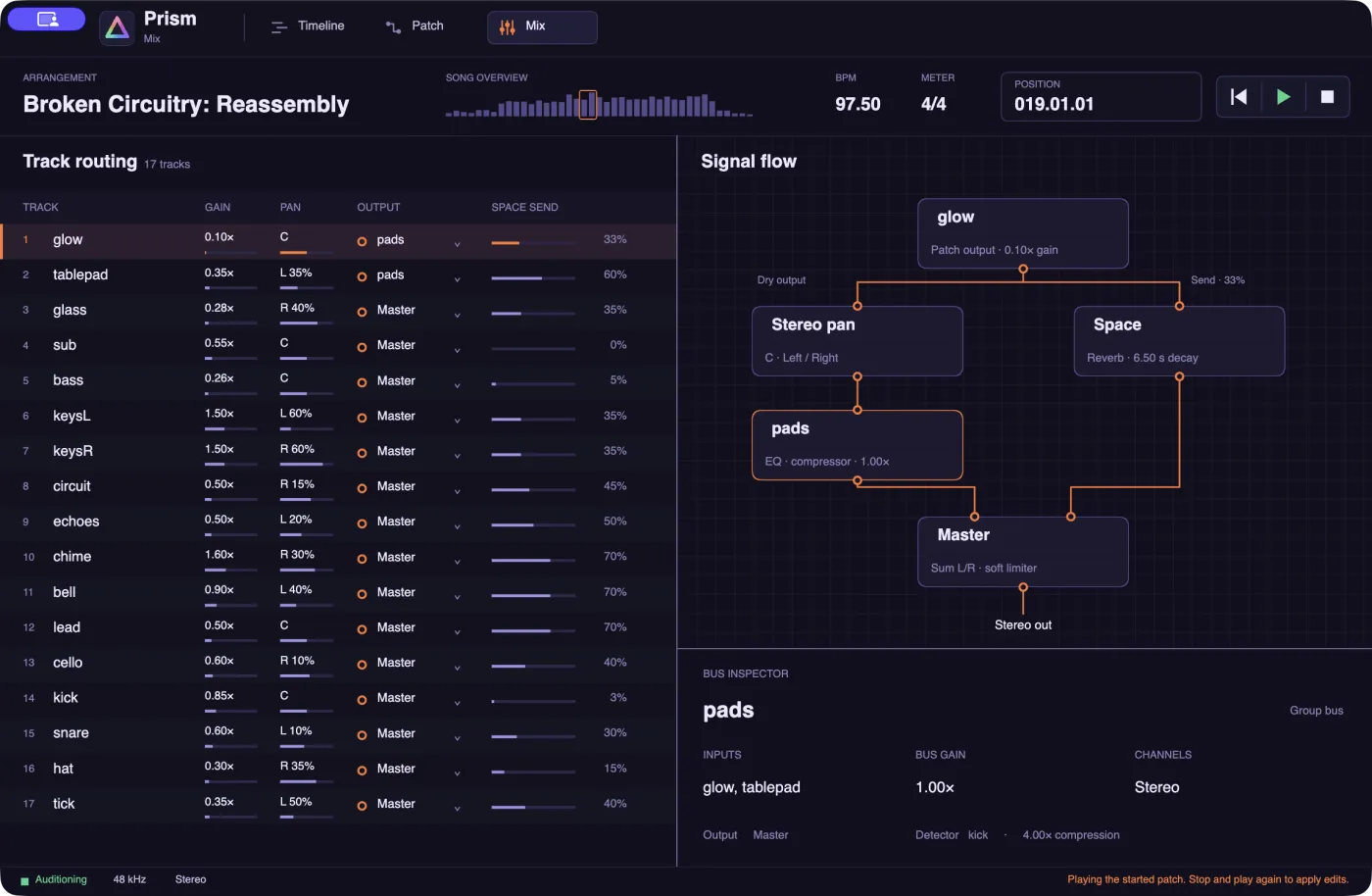
The waveshaper’s antiderivative antialiasing and the reverb’s damping and diffusion live in nonlinear_math.ospml. The synthesis proof suite reads the production Osprey functions named in the synthesis specification, and checks the resulting proofs on GC, ARC and WebAssembly. Run make _test_synthesis_proofs to check them locally.
Where a formula calls floatDiv, it uses IEEE floating-point division. The / operator raises an Arith effect on division by zero. The renderer wraps an overflow and turns a division by zero into silence:
main () =
    handle Arith
        overflow _ _ _ wrapped => wrapped
        divideByZero _ _ => 0.0
        remainderByZero _ => 0
    started (request (args ()))
The policy is one handler you can read and replace, not a crash buried in a plugin.
Why write it in Osprey
- No collector pauses. Prism and its renderer build with
--memory=arc, which uses reference counting, so memory is freed at known points rather than by a garbage collector that stops the program. - Failures are values. A malformed patch, an out-of-range parameter or an unreadable sample returns a typed error. Osprey code never panics or aborts.
- The oscillators share one implementation. Native Osprey functions in
waves.ospmlsupply the polyBLEP and polyBLAMP corrections. - One project file. Notes, patches, routing and mix live in one JSON file, defined by a typed model (
daw.td). Every edit in the film was saved to it, so a song diffs and versions in git like code.
Run it
make -C src/toolchain/targets/macos prism          # install Prism for Spotlight
make -C src/toolchain/targets/macos daw-render SONG=src/osprey/examples/daw/tracks/phosphor-drift.json
make -C src/toolchain/targets/macos daw-play SONG=src/osprey/examples/daw/tracks/phosphor-drift.json
daw-render bounces a song to target/daw/<song>/song.wav with no window, so a mixdown can run from a script.
Current limits
- Offline rendering: Play renders the selected bars offline and then plays the file; there is no real-time audio callback yet. A patch edit made while a patch is playing is heard after you stop and play again.
- Platforms: the full DAW runs on macOS. On Windows, only the Prism patch editor runs today.
- Plugins: VST3 hosting is incomplete, and a patch that holds a VST3 node can't be saved yet. CLAP and MPE input are not supported.